
"there has only ever been one perfect man, the Lord Jesus, and we killed him. I only missed a putt."
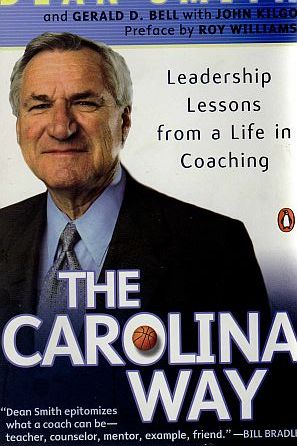
The Carolina Way
Return to the book list for titles beginning with 't'.
The Carolina Way, Dean Smith, Penguin books, 2005 ISBN 014 30 3464 2 (337 pages)
The book sets out the coaching philosophy of Dean Smith, basketball coach of North Carolina for 40 years. Each of the 26 chapters has a section by Deam Smith, followed by a testimony by one or more ex-players and a business application.
The fascination of the book for me was the principles by which Smith coached
There were three basic principles: Play hard, play together, play smart. "Hard meant with effort, determination, and courage; together meant unselfishly, trusting your teammates, and doing everything possible not to let them down; smart meant with good execution and poise, treating each possession as if it were the only one in the game." (page 28ff)
Smith had a great record of winning, how did he achieve it?
"Our North Carolina players seldom heard me or my assistants talk about winning. Winning would be the by-product of the process. There could be no shortcuts. Making winning the ultimate goal usually isn't good teaching...So many things happened in games that were beyond our control: the talent and experience of the teams; bad calls by officials; injuries; bad luck". (page 29)
This is confirmed by players: "I never really heard him talk to any of his teams about winning. Instead he talked about doing our best, improving each day, playing hard, smart, and together". Phil Ford, Page 312 Coach Smith seldom talked about winning. Instead he talked about the things we needed to do to be successful. He never got too high after winning or too low after a loss. He talked to us about what we did well and what we did poorly regardless of the outcome of the game. Bobby Jones, ex Carolina player (Page 43)
Another principle was unselfishness
"We went to great lengths to reward unseIfish behavior, and we profusely praised those acts that we wanted to see repeated. One man who failed to do his job unselfishly could undermine the efforts of the four other players on the court. (Page 13 and 30)
Smith was not interested in official stats. He had the "Coaches' honor roll, which rewarded unselfish play etc (Page 178-9)
We learned to play together, unselfishly. No one cared about individual scoring averages or newspaper headlines. The important thing was to play together as a unit to beat the other team. Steve Previs, Carolina player (Page 32)
"Coach Smith's defense also taught us that each man on our team needed to depend on and trust his teammates, while at the same time instilling in us the strong desire not to let a teammate down. This unselfishness, bred on defense, worked its way through all parts of our game and was the hallmark of Carolina basketball... Selfish players, no matter how good they were, did not play for Coach Smith. His players had to be 'teammates' in the ultimate sense of the word, or they did not play. He taught us that a pass that led to a basket was every bit as important as the basket itself, and the scorer should thank the passer by pointing to him. If a man dived on the floor for a loose ball, his teammates were expected to rush to his side and help him up. Little things that helped us succeed were celebrated under Coach Smith". Charles Shaffer, Carolina player (Page 80 and 83)
The book is full of great stories from game situations. Once when North Carolina were winning a tight game against a team which had beaten them last time and gloated, Smith called a time-out: "The players were understandably excited near the end of the game. I called them over to our bench and told them, 'Finish this off with class. Shake their hands and congratulate them -and then we'll celebrate in the dressing room with the door closed."(Page 42)
Smith used what was called the "tired signal" to enable players to take a break and not stay on court in case they would not get back on again. The player could decide when to return. "In I973, Ed Stahl, one of our big men, gave the tired signal, and I replaced him with freshman Mitch Kupchak. About four minutes passed, and Ed was still on the bench. 'Aren't you ready yet?' I asked. He replied that Mitch was playing so well that he didn't think he should replace him". (Page 181)
Quotes from players
Playing for Coach Smith completely changed my approach to handling adversity. Whether we won or lost, he taught us that we should embrace the process of testing ourselves and have fun doing it. If ever faced with a daunting task that appears to have a high chance of failure, I think back to Coach Smith's message that regardless of whether the goal is achieved, my worth as a person is constant and I should relish the challenge of testing myself. Ex Carolina player Charles McNairy, Page 23
I got a great coach for 4 years and a close friend for a lifetime Phil Ford, Page 93
I learned about a lot more than basketball playing for Coach Smith. He taught us life's values: loyalty, the importance of teamwork, our obligation to follow through on our responsibilities. He stressed that if we lost, we should accept it as a loss and not blame someone else. Learn from it; hold up our end; no finger-pointing. What he taught us mirrors life and that is what I try to teach my children today, Charles Scott, Carolina Player, Page 300