
"God answers my prayers everywhere except on the golf-course."
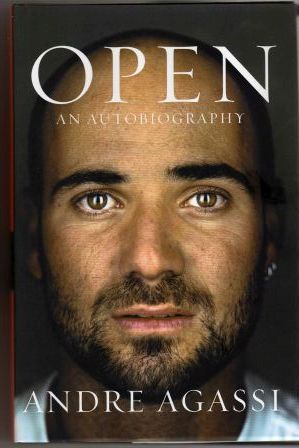
Open
Return to the book list for titles beginning with 'o'.
Andre Agassi, Harper Collins, London 2009. ISBN 978-0-00-728142-8 388 pages
When this book was first published, all the publicity was about the drugs issue – that Agassi had taken recreation drugs and had lied to escape a ban. The drugs issue takes up a few pages and is incidental to a phenomenal book.
Well-written witty, captivating. It gives a gripping insight into the mind of the player. Forced to play tennis from an early age, Agassi wrestles with the dilemma of hating tennis yet being frightened to give it up.
At times he is very philosophical: "Part of my discomfort with tennis has always been a nagging sense that it’s meaningless. Now I’m about to learn the real meaning of meaninglessness". (Page 255) or after becoming world number 1
"I spend many hours roaming the streets of Palermo, drinking strong black coffee, wondering what the hell is wrong with me. I did it— I'm the number one tennis player on earth, and yet I feel empty. If being number one feels empty, unsatisfying, what's the point? Why not just retire?" (Page 204)
The book begins with an amazing account of an epic match with Bagdadis where both players play beyond the point of exhaustion. The book takes the reader deeper into the mind of the competitor than anything I have read. For example the experience of defeat:
"People, I think, don’t understand the pain of losing in a final. You practice and travel and grind to get ready. You win for one week, four matches in a row. (Or, at a slam, two weeks, six matches.) Then you lose that final match and your name isn’t on the trophy, your name isn’t in the record books. You lost only once, but you're a loser". (Page 130)
"..this allows Becker to capture the momentum. He never gives it back. He wins in four sets. The loss is one of the most devastating of my life. Afterward, I don't say a word to anyone. Gil, Brad, Brooke — I don’t speak to them because I can't. I am broken, gut-shot". (Page 209)
After he wins an epic match with Edberg in searing heat – throwing up during match and during presentation, there is the statement "Brooke asks why I didn’t just quit." (page 212). No answer is given. It is, rather, implied that anyone who understands sport – as Brooke Shields does not – would never ask the question.
Another insight into his mind comes in the reference to the shower, lasting 20 minutes, that he takes before all his matches."I've won 869 matches in my career, fifth on the all-time list, and many were won during the afternoon shower". (Page 9).
Given that Agassi was often referred to as a Christian, the references to God in the book are interesting. There is one reference to prayer (Page 59) and a reference to going to church for a while (Pages 123-126). Yet his language is rich throughout the book.
He also finds Michael Chang’s overt Christianity irritating: "Every time he beats someone, he points to the sky. He thanks God— credits God—for the win, which offends me. That God should take sides in a tennis match, that God should side against me, that God should be in Chang's box, feels ludicrous and insulting". (Page 118 and also130 and 151) And again "So I’ll lose today. Congratulations, Chang. I hope you and your Messiah will be very happy". (Page 226).
I was left wondering whether proclamation evangelism by sportpeople puts off more people than it affects positively.