
"God answers my prayers everywhere except on the golf-course."
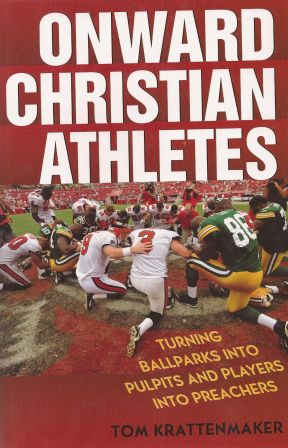
Onward Christian Athletes
Return to the book list for this category.
Turning Ballparks into pulpits and players into Preachers,Tom Krattenmaker. ROWMAN & Littlefield. 2009. 220 pages
"What does religion have to do with sports, anyway?" is a question this book asks. Or to put it more dogmatically "When you're in the stadium, and they’re giving you the Super Bowl trophy, that’s a captive audience. That’s not the time to push your faith."
The book, written by an American journalist who describes himself as "while...not an evangelical Christian, I am not the least bit opposed to the Christian faith" is an analysis of the role of evangelical Christianity in American sport.
In ten chapters the book reviews the role of evangelical chaplains, the exclusivity of evangelical theology, the identification with Republican politics, winning for God, the race issue among other topics.
Krattenmaker suggests that "Christianity's strong presence in sports is no accident. It happened because a movement of athletic-minded evangelical Christians have been making it happen since setting out more than half a century ago to reach and convert athletes and leverage their influence to spread the gospel to the wider sports-loving public." The book documents the process and distils principles from real examples of how Christians are "leveraging sports to communicate the Christian message".
Some of the examples made me cringe – like the NFL player who said "it was his increased tithing at church that elevated his performance and healed his persistent hamstring injury" and players who attribute their success to God. Krattenmaker very reasonably asks why no Christian athletes seem to want to thank God publicly for a defeat. [If God wants one team to win then presumably he wants the other team to lose.]
The book makes a number of criticisms of the evangelical approach to sport including:
1 The lack of any serious theological thinking about sport. He agrees with Ladd and Mathisen that evangelicals in sport have no agreed theology. "Commitment to evangelism as its overriding organizing principle...has made spreading the faith a higher priority than upholding fidelity to sound theology”. It is a case of “the high-achieving religious athlete has something of a deal with the Lord, the terms of which go like this: God has placed the player in his position of success and influence so that he may use the platform to celebrate and promote the faith."
2 The exclusivism of evangelical chaplaincy - which states that all other religions are wrong "and thus makes it difficult to have meaningful dialogue and healthy working relationships between people of different faiths".
3 Turning a blind eye to the ethical issues – excessive violence, race, sexual-titillation by cheer-leaders – because they are afraid of losing their privileged position of insider access or because they "depend on the games remaining basically what they are...to command the massive audiences the ministries want to reach".
4 The evangelical assumption "that Jesus would accept the basic premises of the athletic mega-industry, maybe even join in as another rugged competitor on the diamond, gridiron, or court". But, Krattenmaker asks, "is it not more likely that Jesus would challenge our obsession with our games?"
5 The lack of a prophetic voice "against the abuses of sports, against sports’ propensity to exploit and discriminate, against the sports world’s out-of-proportion obsession with winning".
At the end of the book he calls for a “more constructive engagement between faith and pro sports [which] must take on some of the following challenges.
1 Christian ministry in pro sports must address sports’ pressing race issues.
2 Christian ministry in sports must challenge the worship of winning and all that follows it.
3 Christian ministry must share the territory with those who believe differently”.
He argues that the Christian message would "come through louder, and resonate clearly and with far more listeners, when it is expressed through your ethical witness in addition to your get-Jesus evangelism".
The fundamental question raised in the book - as referred to above – is the legitimacy of sports evangelism. Is it appropriate to use sport, with its potential to unite communities, to communicate a "potentially divisive brand of evangelical Christianity"? He quotes a Christian (non-evangelical) pastor "People come to see a baseball game, not be exposed to politics or religion," and a Rabbi whose concern is "people using their personal social capital as a player to evangelise for their particular faith and doing it with the imprimatur of their team". This is a fundamental question I have never heard discussed at any Christian sports ministry meeting.
Krattenmaker raises the case of Reggie White an NFL legend and strong evangelical Christian spokesman during his illustrious career. Shortly before his sudden death in late 2004, White went public with claims of being exploited by pastors and ministries. "Really, in many respects I've been prostituted. Most people who wanted me to speak at their churches only asked me to speak because I played football, not because I was this great religious guy or this theologian...I got caught up in some of that until I got older and I got sick of it". I can think of a good number of other professional sportspeople who feel exploited rather than supported by Christian ministry.
One of the most fascinating elements of the book is its plea for a different type of chaplaincy from the North American evangelical model as the author perceives it. The new approach to chaplaincy might be described as being humble and not arrogantly right, thinking beyond evangelism, seeing athletes "not principally as targets for conversion, but as complicated and often-hurting human beings", caring for "the well-being of a population of athletes plagued by sky-high rates of doping, addiction, marital health", aiming "not primarily to satisfy their own need for religious self-expression or to advance their particular faith, but to serve the clients and seeking to transform pro sport into an entity that serves communities and builds solidarity between peoples and cultures. Krattenmaker calls it "service-first form of chaplaincy". Perhaps I missed something but surely this is exactly what Christian chaplaincy in sport should be.
This is an important book. Of course Krattenmaker is not right in all his analysis but he asks some great questions. It is fascinating to read the insights of an intelligent outsider on the evangelical interaction with sport. Where we think the author is wrong, his questions will help us think through and articulate a Biblical justification for our ministry strategies. It is a book that deserves to be read by Christian sports ministry personnel – unless, of course, we think we know it all.